Assessing the cause
Before stabilising a tree, we look at why it has moved, whether from wind, soil movement, root damage or poor planting, so the solution addresses the real issue.
Practical help for leaning, wind-rocked or partly uprooted trees, assessing whether they can be safely stabilised and kept, or should be removed.
Tree stabilisation in Hamilton helps keep leaning, loosened or newly planted trees secure. After storms, soil movement or root damage, a tree may shift or lean, creating a hazard. Our arborists assess whether the tree can be safely stabilised and use appropriate methods such as staking, guying, anchoring and ground support. We always consider the cause of the movement, because stabilisation only works when the tree has enough root hold and structural health.
We'll be honest if the tree is beyond saving and removal is the safer option. For young trees, proper staking helps roots establish while protecting against wind. Work is done carefully to avoid damaging the bark. Stabilisation is a good alternative to removal in the right circumstances. Contact us for tree stabilisation in Hamilton and get practical advice on keeping your tree secure.
Before stabilising a tree, we look at why it has moved, whether from wind, soil movement, root damage or poor planting, so the solution addresses the real issue.
Stakes, ties and guy lines can support young or newly planted trees, helping roots establish securely while protecting the trunk from damage.
In some cases, we use ground anchors and bracing systems to support leaning or loosened trees, as long as there's enough healthy root hold for this to work.
We choose straps and fittings that don't cut into bark or restrict growth, and we recommend adjustments over time as the tree develops.
Some trees are too unstable to save, and we'll tell you honestly if removal is the safest choice rather than leaving a hazard in place.
After stabilisation, we can recommend a schedule for checking the tree, adjusting supports and removing stakes once the tree is strong enough to stand alone.
A leaning or loose tree needs careful assessment before anything is installed. Our Hamilton specialists look at why the tree has moved, then use suitable staking, guying or anchoring to support it without harming the bark. We're honest about when stabilisation will work and when removal is safer, and we advise on follow-up checks.
Contact an arborist promptly if you notice any of the following:
A new or increasing lean, especially after wind or heavy rain
Cracked, lifted or mounded soil on one side of the trunk
Exposed or snapped roots near the base
A young tree that rocks freely in its planting hole
Recent excavation or trenching close to the trunk
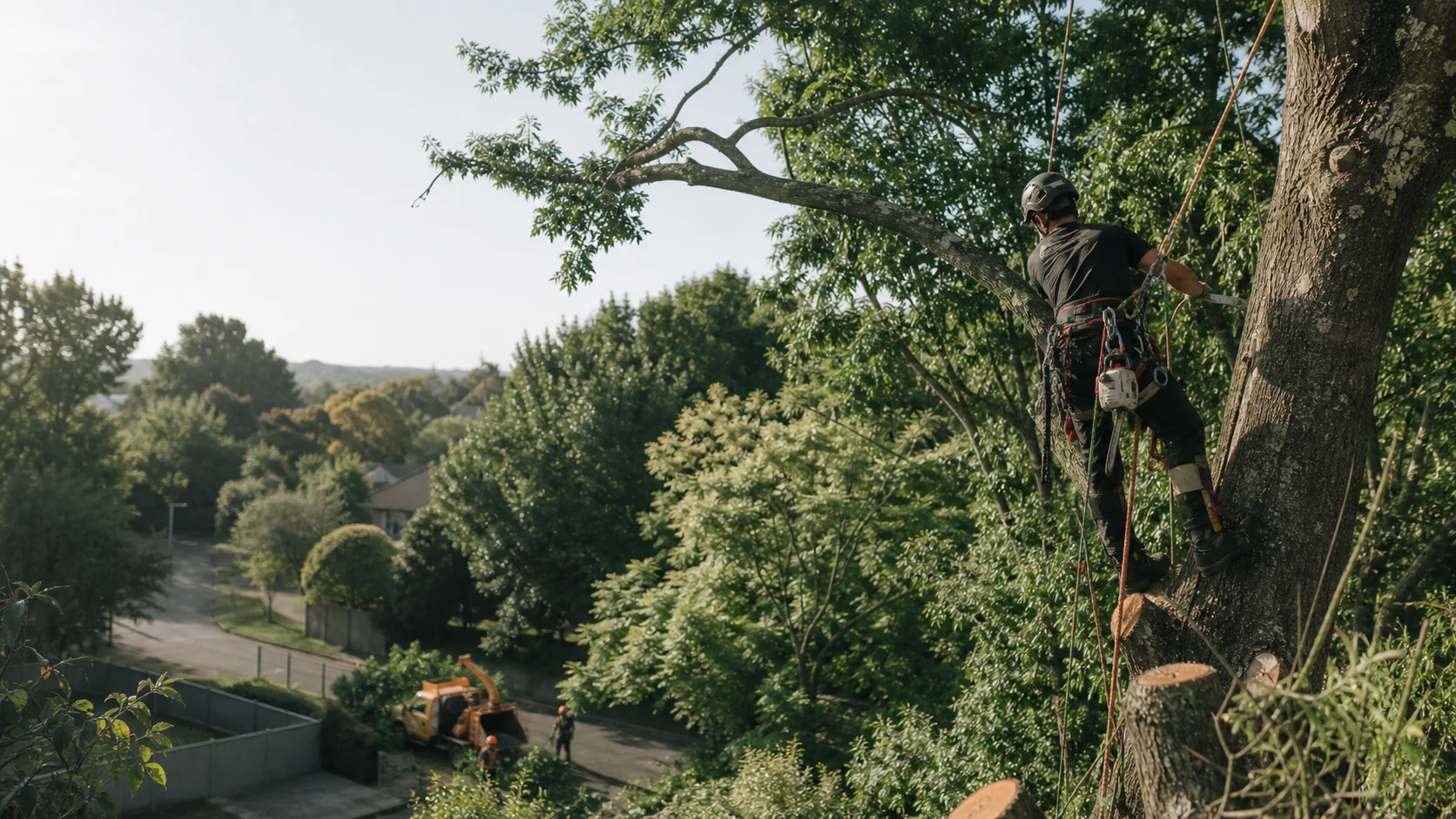
We inspect the tree, roots, and soil to see why it is unstable, and judge whether it can be saved and supported or whether removal is the safer option.
Depending on the tree, we use staking, guying, cabling, or targeted pruning to reduce movement and restore stability, helping the tree anchor itself and recover safely.
We advise on follow-up checks and care so your tree stays upright and safe as it recovers, and we flag any warning signs worth watching closely over time.
Answers to common questions about tree stabilisation in Hamilton. Still have a question? Get in touch.
Small young trees can sometimes be straightened and staked while their roots are still developing. Established trees are different, as pulling them upright can tear roots and make them less stable. A tree that has leaned gradually for years may also have adapted and be quite stable. We'll assess the roots and soil before recommending anything.
A sudden new lean, especially with cracked or lifted soil around the base, should be treated as urgent if the tree could reach a house, road, power line or area where people go. Keep everyone clear and call us on 07 808 5077. If the tree is near power lines, stay well away and contact WEL Networks.
Stakes should only stay until the roots have anchored the tree, which is often around one or two growing seasons, depending on the species and site. Leaving stakes and ties on too long can rub the bark and weaken the trunk. We'll check the tree and let you know when the supports can safely come off.
Stabilisation deals with the whole tree's anchorage, such as a tree that is leaning, rocking or partly uprooted, using staking, guying or ground anchors. Cabling and bracing support weak parts within the canopy, such as a poor branch union or split stem, while the tree itself stays firmly rooted. Some trees need one approach, others need both.
The cost depends on the size of the tree, the cause and severity of the movement, the support method needed and access to the site. Staking a young tree is a small job, while anchoring a larger tree takes more equipment and time. We'll assess the tree and give you a free quote, along with an honest view on whether stabilisation is worthwhile.
Tell us about your tree stabilisation job and our insured Hamilton arborists will assess the site and give you a clear, no-obligation price. Prefer to talk it through? Call us on 07 808 5077.
Get a Free Estimate